


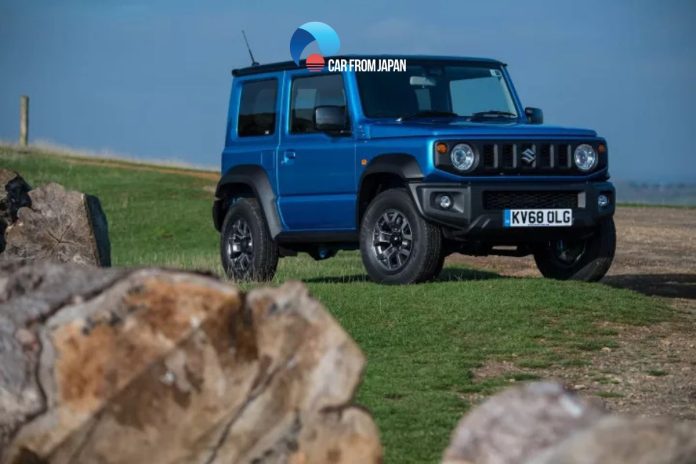
Let’s break down the story of the challenges when import Suzuki Jimny and why it remains America’s favorite forbidden JDM car!
Somewhere out there, on a muddy trail in the English countryside or navigating a tight street in Tokyo, is a tiny, boxy, impossibly charming little SUV.
This is the Suzuki Jimny! It’s affordable, it’s reliable, and it’s packed with more personality than most cars three times its size.
It seems like a no-brainer for the American market, a country obsessed with SUVs and the idea of adventure. So why can’t you walk into a dealership and buy one? Why is this perfect little SUV treated like forbidden treasure in the USA?
The answer isn’t one simple thing!
Contents
The History of The Suzuki Jimny
To understand why the Jimny isn’t here today, we have to travel back in time to the 1980s and meet its ancestor: the Suzuki Samurai. When the Samurai first arrived in America in 1985, it was a sensation.
In a world of big, clunky SUVs, this little Japanese 4×4 was a breath of fresh air. It was cheap, you could buy one for about $6,500. It was great on gas, and it could scamper up trails.
Young people, beachgoers, and first-time car buyers fell in love. It was the ultimate “fun” car. Sales exploded. In its first year, Suzuki sold nearly 50,000 of them.
By the second year, that number was over 80,000. The Samurai was a certified hit, and Suzuki looked like it had a permanent home in the American market.
Then, in 1988, everything came crashing down. The magazine Consumer Reports – a source for product testing, published a scandalous review.
They claimed that during an emergency swerving test, the Samurai was prone to tipping over onto two wheels and could easily roll over. They slapped the vehicle with a not-acceptable rating, the worst they could give.
The media went into a frenzy. News reports ran scary-looking footage of the Samurai lifting its wheels during the test.
The damage from this story was immediate and catastrophic. Public perception shifted overnight. The Samurai was now seen as a death trap and its sales plummeted.
Suzuki was furious. They argued that the magazine’s tests were unfair and that they had to swerve in an extreme, unrealistic way to make the vehicle tip. They sued Consumer Reports for libel, starting a bitter legal battle that would last for eight long years.
In the end, they settled out of court, and the magazine acknowledged that their language might have been a bit strong, but they never retracted their rating.
Even though Suzuki didn’t lose the lawsuit, they lost the war for public opinion. The ghost of the Samurai rollover story haunted the company in America for decades.

It created a deep scar on the Suzuki brand, forever linking their small SUVs with the word “unsafe” in the minds of a generation of car buyers.
This bad memory made the company incredibly hesitant to ever again sell a small, high-riding off-roader in the US.
Why Did Suzuki Leave the US Car Market?
The Samurai controversy was a wound that never fully healed, but Suzuki’s American car division limped on for another two decades. They sold other cars, like the Sidekick SUV (which later became the Vitara) and the Swift compact car.
But they were always a small player in a massive market dominated by giants like Ford, Toyota, and General Motors. They couldn’t compete. Their cars were seen as budget options, and their sales numbers were never strong.
In 2012, the American Suzuki Motor Corp announced it would stop selling automobiles in the US.
This is the single biggest and simplest reason you can’t buy a Jimny. Suzuki doesn’t have a car business here anymore.
There are no corporate offices for car sales, no marketing teams, no distribution network, and no dealerships.
To re-launch their car brand in America, Suzuki would have to start from zero. For a company that struggled in the US for years, taking that kind of colossal financial risk on a niche vehicle like the Jimny is simply not a good business decision.
So, they focus on what still works for them in the US: their motorcycle, ATV, and marine engine divisions.
Overall, the legacy of the Samurai might have ended in scandal, but the desire to import Suzuki Jimny units proves that the world still craves this unique, compact off-roader.
Making a Jimny Street-Legal In the USA Would Cost a Fortune
Every single vehicle sold in the USA must first survive a brutal and expensive process called federalization. This means it has to be re-engineered to meet the unique, and incredibly strict, standards of two US government agencies.
First up is the National Highway Traffic Safety Administration (NHTSA), in charge of crash tests and safety equipment.
America’s safety rules are different from those in Europe or Japan. Things like bumper height, headlight placement, roof crush strength, and how a car behaves in specific side-impact crashes are all heavily regulated.
The Jimny, being so small and light, would likely need significant and expensive changes to its frame and body to pass these tests. It would also need specific airbag systems, including sensors and deployment patterns, that are unique to the US market.
Next is the Environmental Protection Agency (EPA). The EPA has its own set of demanding rules about vehicle emissions and fuel economy.
The Jimny’s small, efficient engine is perfect for other parts of the world, but it wasn’t designed with California’s stringent emissions standards in mind.
To make it compliant, Suzuki would have to re-tune the engine, add different catalytic converters, and ensure it works with America’s specific onboard diagnostic systems (the OBD-II port a mechanic plugs into). This process can cost a fortune and sometimes even hurts the engine’s performance.
In general, the cost of re-engineering and certifying a Suzuki Jimny for the US market can run into the hundreds of millions of dollars.
A Way To Import Suzuki Jimny To USA: The 25 Year Import Rule
For now, the only way for an American to legally own and drive a Jimny on public roads is to wait 25 years.
Thanks to the 25-Year import rule, once a vehicle hits that age, it becomes a classic and is exempt from most modern safety and emissions standards.
So, in a few years, you might start seeing a handful of late-90s Jimnys popping up for sale.
Until then, the desire to import Suzuki Jimny will remain what it is today for Americans: a dream, a forbidden off-roaders.

You can opt for a Suzuki Jimny for sale in decent condition on reputable auto car buying platforms in the US, and Car From Japan is the one worth checking for.
For more insightful information on how to import Suzuki Jimny and other beloved JDM models around the world, follow us today to not miss any pieces of your journey to bring a dream car home!