



When having a car, whether new or used cars, drivers should not ignore the car VIN number – Vehicle Identification Number (also known as the chassis number), where it can be “revealed”.
VIN numbers give car owners a lot of important information about the car they are driving. What meaning do the VIN digits contain? And where is the VIN number on a car?
Let’s learn with Car From Japan how to look up the VIN number of a car as well as understand the information on the Vin number in our article.
Contents
- What Is The VIN Number On A Car?
- What Can You Do With The VIN Number?
- What Do The Numbers In A VIN Mean?
- Where Is The VIN Number On A Car?
- FAQs on VIN Number On A Car
- Why do some imported cars have a VIN that’s shorter than 17 characters?
- Can a VIN tell you whether your car was built on a weekend or weekday?
- Can a VIN reveal whether a car has been tuned, modified, or engine-swapped?
- Can a missing VIN plate make a car illegal to sell?
- Why do insurance companies care so much about the VIN?
- What should you do if your VIN doesn’t match the title or registration?
- Conclusion
What Is The VIN Number On A Car?
Like the “identification” of a vehicle, a VIN is unique – a 17-character code assigned to every vehicle when it’s manufactured.
It contains a lot of vehicle identification information such as country of manufacture, vehicle brand, year of manufacture, model, etc. serial number,…help us to identify, manage and look up the origin of the vehicle.
VINs aren’t just some random collections of letters and numbers. They actually follow a specific system that is used across the entire car industry.
Make, model, country, and trim level are encoded in the VIN. So it’s the serial number that makes each VIN unique for every vehicle.
VINs began to appear in 1954 in the US, but there is no official standard. Each auto company builds its own VIN system to manage products.
Since 1981, the US National Traffic Safety Administration NHTSA officially unified the 17-digit VIN standard for vehicles so each vehicle will have exactly one VIN and it stays the same for the vehicle’s entire lifetime.
Besides, Europe as well as countries with a developed auto industry such as Canada, the US, and Australia will have certain standards, but will still be based on the original 17-digit platform.
In the US and Canada, automotive VINs will apply based on FMVSS 115, Part 565. In Europe and most countries, ISO 3779 or SAE J853 will be applied.
While in Australia, the application of the ADR 61/2 standard is quite similar to ISO 3779 and 3780.

What Can You Do With The VIN Number?
In addition to displaying the necessary parameters related to your vehicle, VIN numbers also have other functions:
Trace the origin of used cars
In developed countries, drivers can look up VIN numbers through information intermediaries to trace the origin of used cars when they need to buy and sell them.
For example, in the US and Canada, customers can find information through Carfax by entering the car’s VIN number.
Look up recall models
VIN numbers are also used to help car owners look up the models that are subject to a recall when there is a problem from auto manufacturers.
Manage road vehicles
Besides, VINs are also applied by the motor vehicle management agency, the Traffic Police Department under the Ministry of Public Security, to manage road vehicles.
Read here many drivers are confused that Is the chassis number and VIN the same?
Our answer is they are the same. This is also the chassis number and part of the VIN is selected as the chassis number in the car registration paper.
Related Post: 4 Ways You Can Check A Car’s History Before Buying It
What Do The Numbers In A VIN Mean?
How to read a VIN number? A VIN has 17 characters consisting of digits 0 through 9 and letters (except O, Q, and I to avoid confusion with 0 and 1) with each one specifying a certain detail of your vehicle.
Modern 17-character VINs are split into three sections: the world manufacturer identifier, the vehicle descriptor, and the vehicle identifier. Let’s break it down:
The world manufacturer identifier (first 3 digits of VIN):
The first character string indicates the vehicle’s country of manufacture and the make of the vehicle. The first value tells you the country where the vehicle was assembled.
The second digit will let you know about the manufacturer and the third number tells you the make and brand.
For example, a sedan manufactured by Chevrolet in the US will have the first three VIN 1G1 but also made by Chevrolet in the US, but if it’s a truck it will have the first three VIN 1GC.
The convention table for some countries in the world according to the automotive VIN standard is as follows:
| Country | Representative Character |
| US | 1,4,5 |
| Germany | W |
| United Kingdom | SA – SM |
| Italy | ZA – ZR |
| France | VF – VR |
| Korean | KL – KR |
| Japan | J |
| India | MA – ME |
| China | L |
Or you can note that:
- 1-5 – North America
- 6-7 – Australia and New Zealand
- 8-9 – South America
- S-Z – Europe
- A-H – Africa
- J-R – Asia
The vehicle descriptor (the next five characters)
This section breaks down the vehicle’s brand, engine size, and type. If you are buying a car and you are not sure the seller is being completely accurate about what kind of car it is, this is the section you will want to pay attention to.
This is a series of numbers that are conventions for the specific characteristics of the vehicle.
For example, whether the vehicle is a hatchback or a sedan, equipped with a gasoline or diesel engine. Most car manufacturers use relatively similar rules, but there are certain differences.
For example, the Hyundai Tucson version using a 2.0L petrol engine and a 6-speed automatic transmission will have a 5-digit T8W13.
The Hyundai Tucson version using a 2.0L diesel engine and 8-speed automatic transmission will have a 5-digit VIN of C9W14.
The vehicle identifier (the final 9 characters)
9th digit
The ninth value is a security code to prove that the VIN number is valid and help managers prevent acts of forging VIN numbers of stolen cars.
It will be difficult to check the validity of a VIN number by yourself because it uses a complex algorithm to make sure the check digit matches up with the rest of the numbers in the VIN.
10th number
This number is used to specify the manufacture year of a car. In 1980, cars shipped out would have the letter A. And in 2001, cars were converted to a coefficient from 1 to 9.
Then back to the letter system from 2010. The table below will show you the car’s year of manufacture through the VIN code
| 10th digit | Year | 10th digit | Year |
| A | 1980 | Y | 2000 |
| B | 1981 | 1 | 2001 |
| C | 1982 | 2 | 2002 |
| D | 1983 | 3 | 2003 |
| E | 1984 | 4 | 2004 |
| F | 1985 | 5 | 2005 |
| G | 1986 | 6 | 2006 |
| H | 1987 | 7 | 2007 |
| J | 1988 | 8 | 2008 |
| K | 1989 | 9 | 2009 |
| L | 1990 | A | 2010 |
| M | 1991 | B | 2011 |
| N | 1992 | C | 2012 |
| P | 1993 | D | 2013 |
| R | 1994 | E | 2014 |
| S | 1995 | F | 2015 |
| T | 1996 | G | 2016 |
| V | 1997 | H | 2017 |
| W | 1998 | J | 2018 |
| X | 1999 | K | 2019 |
11th digit
This is the location where the factory code is specified. This number will be internally marked by the automaker for its factories. Each automaker has its own factory number; the final manufacturer’s assembly frequently changes with plants.
Although their codes can be changed by the automakers, this digit position in the VIN has been standardized.
The final six digits (12th digit – 17th digit)
These numbers act as the car’s serial number. They won’t give you any information on the car itself. They exist so that every car has a unique identifier and just a unique VIN.
The last digits of the 17 VIN numbers are used to number the ordinal numbers of vehicles manufactured in the year.
Currently, there is no car factory in the world that can produce a model of up to millions of units per year. Therefore, the VIN system of cars in the world still maintains this fixed structure without any changes.
Where Is The VIN Number On A Car?
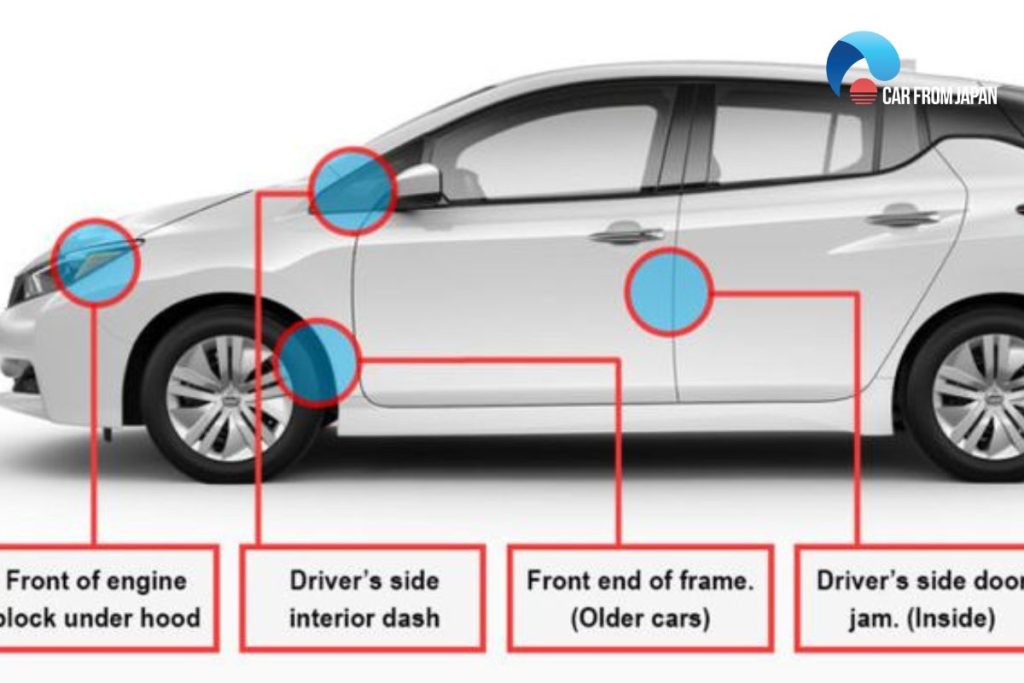
Where do I find a VIN number? Do you want to know that? In this part, we will tell you the most common places to find a VIN number on any car or SUV.
Check the windshield
Check for the VIN number in the bottom corner of the front windshield. Most modern vehicles now have a visible VIN number usually located in the bottom right or left corner of the windshield.
Look for a sticker
Look up a VIN number sticker, or VIN plates located on the inside of the driver or passenger door post. This is also sometimes referred to as the build plate. It will contain various details about the vehicle including the VIN number.
It will either be riveted to the vehicle or more commonly be printed on a tamper-proof sticker that will rip If anyone tries to remove it.
Check the driver or passenger’s footwell
In the driver or passenger’s footwell including just under or to the side of the front seat. Many vehicles have the VIN number stamped on the floor.
It will be either under a flap of carpet or there will be a lift-up plastic cover giving access to the VIN number.
In the engine compartment
First, you should open the hood, on some older cars there’s often a VIN plate riveted on the front panel, more often the number is stamped into the firewall just below the rain channel.
Check in the boot or trunk
The VIN number is on some cars occasionally located in the boot or trunk area. It’s stamped or on the VIN plate or VIN sticker found under the carpet.
On the chassis
For many vehicles, usually the larger 4 by 4 vehicles such as Land Rover, you can find the VIN number on the chassis frame ( behind or just in front of the front wheel).
To view this, you should turn the wheel to the right and check along the flat surface that faces you.
Read More: Pros and Cons of Leasing vs. Buying A Car
FAQs on VIN Number On A Car
Why do some imported cars have a VIN that’s shorter than 17 characters?
Many older JDM or European cars didn’t follow the 17-digit standard before 1981. These shorter VINs are normal for classic imports and don’t indicate tampering.
Can a VIN tell you whether your car was built on a weekend or weekday?
Indirectly. While not encoded explicitly, the VIN can reveal production plant and sequence number, which enthusiasts sometimes correlate with build-quality patterns.
Can a VIN reveal whether a car has been tuned, modified, or engine-swapped?
No. VINs show original factory configuration. If the car has undergone modification, the VIN will not reflect those changes.
Can a missing VIN plate make a car illegal to sell?
In many countries, yes. A car without visible VIN identification may be treated as suspicious or stolen until verified through secondary stampings.
Why do insurance companies care so much about the VIN?
The VIN determines exact risk factors: engine size, trim level, safety features, market value, and even theft probability.
What should you do if your VIN doesn’t match the title or registration?
Stop immediately. Mismatched VINs may indicate clerical errors, frame swaps, or potential stolen vehicle issues. Authorities or DMV verification is required.
Conclusion
Looking up VIN numbers is a very necessary thing to do, especially when you buy a used car.
Hopefully, with the information about where is the VIN number on a car, you already know how to read, understand and find exact VIN numbers on your vehicle.