



Is the Subaru Sambar just a Daihatsu Hijet with a different badge? For any truck built after 2012, yes. Subaru has sold a rebadged Hijet since then, so the size, engine, and chassis are the same. But go back further, and the older Sambar was a very different truck, with its engine at the back and an optional supercharged four-cylinder. So which one is right for you? It depends on the year.
Contents
Subaru Sambar Truck Overview
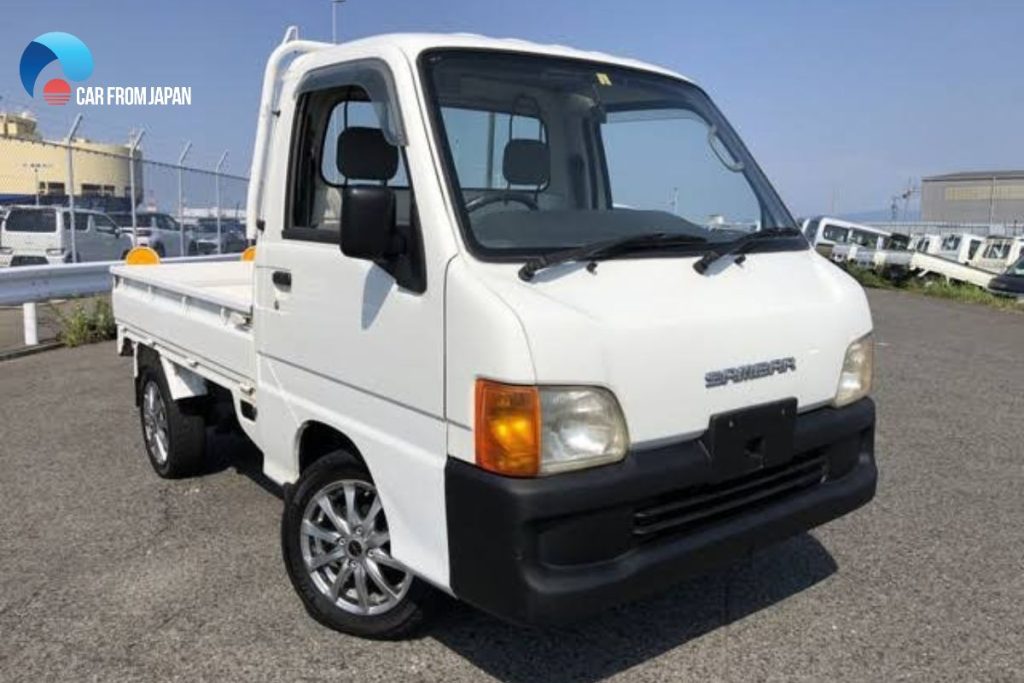
The Sambar is one of Japan’s oldest kei trucks, and for its first 50 years it was designed and built by Subaru itself. Subaru launched it in 1961, and Wikipedia describes it as the second truck built to Japan’s kei class rules, after the Kurogane Baby. Its story splits into two parts: the years when Subaru engineered the truck, and the years after 2012, when it became a rebadged Daihatsu.
Japan raised its kei engine limit to 660 cc in 1990, and the fifth-generation Sambar took advantage with a four-cylinder engine called the EN07, shared with the Subaru Vivio. It made 40 PS in standard form and 55 PS with a supercharger, which made the Sambar the only kei truck rival with four cylinders. The sixth generation arrived in 1999 with a slightly wider body, after Japan widened the kei width limit to 1,480 mm in October 1998, and the supercharged engine rose to 58 PS.
Daihatsu Hijet Truck Overview
The Daihatsu Hijet Truck is a cab-over kei truck that Daihatsu has built since November 1960, making it one of Japan’s longest-running work trucks. Today’s tenth-generation model (S500/S510) has a mid-mounted 658 cc three-cylinder engine, available with 2WD or 4WD, and makes 46 PS with the 5-speed manual or 53 PS with the automatic.
It measures 3,395 mm long and 1,475 mm wide, with a standard cargo bed 1,940 mm long, so it fits Japan’s kei size limits while hauling a lot for its size. Daihatsu had sold around 7.4 million Hijets (trucks and vans combined) in Japan by November 2020, and in December 2010 the Hijet became Japan’s top-selling kei truck for the first time in 39 years. The same truck is also sold as the Toyota Pixis Truck and, since 2012, as the Subaru Sambar.
Subaru Sambar vs Daihatsu Hijet Truck: Side-by-Side Comparison
The two trucks were close in size but built very differently. The table summarizes the typical 2000s trucks (Sambar sixth generation, Hijet ninth generation), and the sections below explain each point:
| Subaru Sambar | Daihatsu Hijet | |
| Engine | 4-cylinder, 658 cc | 3-cylinder, 660 cc |
| Power | 46–48 PS (naturally aspirated), 58 PS (supercharged) | 43–45 PS (EF-SE), 48–53 PS (EF-VE) |
| Torque | 58 N·m (naturally aspirated), 74 N·m (supercharged) | 57 N·m (EF-SE), 63 N·m (EF-VE) |
| Engine position | Rear | Mid, under the seats |
| Rear suspension | Independent (semi-trailing arm) | Leaf-sprung axle |
| Length x Width | 3,395 × 1,475 mm | 3,395 × 1,475 mm |
| Wheelbase | 1,885 mm | 1,900 mm |
Size and weight
Both trucks were the same length and width, because both were built to Japan’s kei limits. A 2004 Sambar Truck was 3,395 mm long and 1,475 mm wide, with a 1,885 mm wheelbase and a 3.9 m turning radius.
The Hijet S210P was the same length and width, with a 1,900 mm wheelbase, 160 mm ground clearance, and a 3.8 m turning radius. Height depends on the cab: the Hijet’s standard cab was 1,780 mm tall, while the Sambar listing is the supercharged High Roof version at 1,860 mm.
Weight varied by grade. The Hijet Special weighed 750 kg with a 5-speed manual and 770 kg with a three-speed automatic. The supercharged High Roof 4WD Sambar listed at 820 kg. These are different grades and drivetrains, so the gap mostly reflects equipment rather than design.
Engine and performance
The Sambar had the more powerful engines. In its 1999–2012 form, the naturally aspirated EN07 made 48 PS and 58 N·m, while the supercharged version made 58 PS at 6,000 rpm and 74 N·m. The Hijet’s naturally aspirated EF engines made 43–45 PS and 57 N·m in the SOHC EF-SE, and 48–53 PS and 63 N·m in the DOHC EF-VE. The supercharger gave the Sambar about 5 PS more than the Hijet’s best engine, and noticeably more torque.
Another difference is the cylinder count. The Sambar’s engine had four cylinders, which Subaru borrowed from its kei cars, while the Hijet used three throughout. The Hijet also had a supercharged engine, but it was sold only until March 1990.
Engine position and layout
The two trucks put the engine in different places. The Sambar’s engine sat at the rear, behind the cargo area, with rear-wheel drive and body-on-frame construction. The Hijet’s engine sat under the seats in the middle of the truck, and the front seats lift to reach it. This is why the Sambar is considered the more unusual kei truck. It’s rated as the smoothest and quietest kei truck it sells, which is the dealer’s opinion rather than a measurement.
Suspension and brakes

The two models used MacPherson struts at the front, but the rear differed. The Sambar had an independent rear suspension, a semi-trailing arm design. The Hijet used a leaf-sprung axle, a simpler design that suits heavy loads. The 2004 catalog entries list front disc brakes and rear drum brakes on both, with the same 145R12-6PR tire size.
Four-wheel drive and transmissions
Subaru Sambar and Daihatsu Hijet also were available with four-wheel drive, though they arrived at different times. The Sambar offered it from 1980, with dual-range 4WD from 1982 and full-time 4WD with a viscous coupling in the 1990s. The Hijet followed in 1982. For transmissions, the Hijet S210P was sold with a 5-speed manual or a three-speed automatic. The Sambar offered a manual, plus an ECVT automatic until 1995 and a three-speed automatic after that.
Cab and options
Additionally, they had a simple two-seat cab, and the choice was about headroom. Daihatsu’s Jumbo cab, offered from 1983, was a high-roofed extended cab with more seat travel, folding seatbacks and a small storage space behind the seats. Subaru offered a high-roof version too, and a retro “Dias Classic” appearance pack that was later offered on the Sambar truck.
Wrapping Up
Before 2012, the Sambar and the Hijet were two different answers to the same kei truck rules. The Sambar had a rear-mounted, supercharged four-cylinder and independent rear suspension. The Hijet had a mid-mounted three-cylinder and a simple leaf-sprung axle. Subaru stopped building its own kei trucks in 2012, which is why the older Sambar is the one collectors look for.