



Are CVT transmissions reliable? This type of automatic transmission is now very common because it helps save gas. But for years, drivers have worried that CVTs break down too easily and cost a fortune to fix. This has created a lot of confusion. We’re here to give you the simple, honest facts about CVT reliability. We’ll show you what to expect from these transmissions and what you need to do to keep them running for the longest time possible:
Contents
What Is A CVT Transmission?
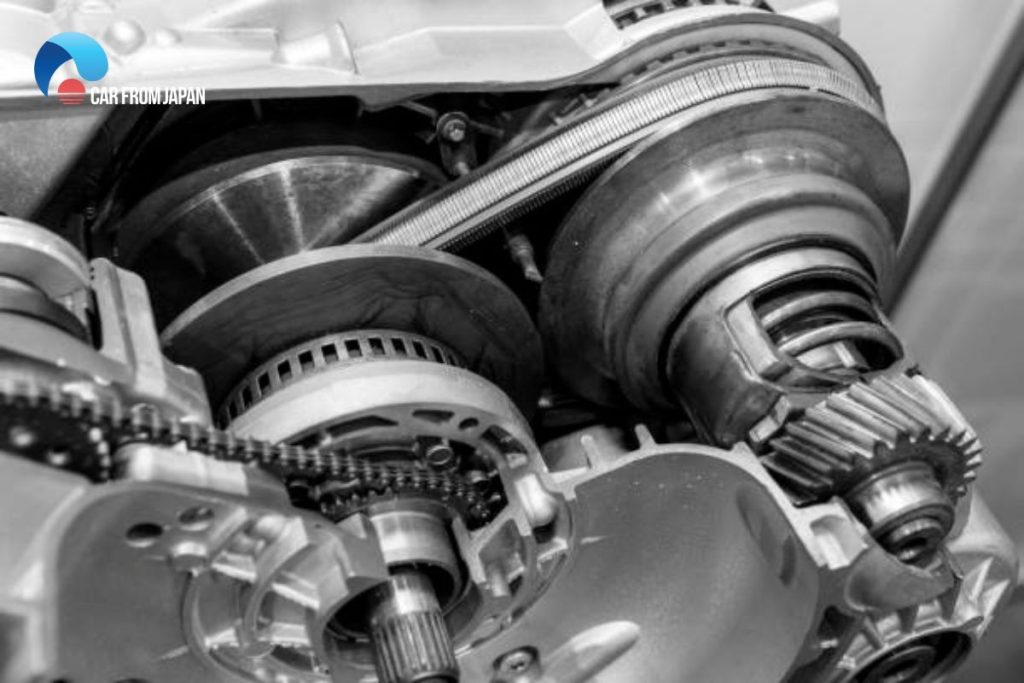
The CVT transmission, or you can call it “Continuously Variable Transmission”. CVT gearbox has no gears, so its operation is much simpler than traditional manual transmission and automatic transmission. Basically, this transmission usually operates on a pulley and belt system that allows for continuous changes, without separating the gears.
It can be seen that CVTs take a very different approach to managing the engine when compared to a conventional automatic transmission. The structure of a CVT transmission consists of three main components: a metal or rubber transmission belt, a variable input pulley system attached to the motor shaft, and an output pulley system leading to the wheel.
When driving a car with a CVT, the transmission adjusts to the engine at its most efficient RPM through the entire acceleration process, compared to the regular automatic transmission, where you can feel the gear changes as you’re accelerating.
What Are The Pros And Cons Of CVT Transmission?
Questions are raised about why many automakers are switching over to CTVs. Is a CVT transmission good? Our answer is “Yes”. In addition to the obvious benefits of this type of transmission, it still has some disadvantages compared to other automatic transmissions. That’s why we will go deeper into analysing the advantages and disadvantages of CTV transmission.
3 advantages of using CTV transmissions
Improve the fuel economy of the vehicle
CVT gearbox has a stronger point compared to other types of gearboxes in the ability to optimise the kinetic energy generated. Unlike an AT or manual transmission, a CVT automatic transmission is designed to help the engine maintain a constant speed with the kinetic energy made.
The CVT gearbox will be most effective when driving on the highway at a stable speed, and then you will find your vehicle offers better fuel economy compared to other types of transmission. Using the CVT gearbox with the Cruise Control system in your car will bring into play the effect of improving the car to save fuel, but the accompanying condition is that the driver must control the car smoothly, avoiding sudden throttle.
Lighter weight
A CVT transmission has a simple structure and fewer parts than a traditional manual transmission or an AT gearbox to help reduce the vehicle’s weight. It also has fewer errors during use. CVTs do not have physical gears like automatic and manual transmissions. It uses a belt and pulley system to shift through constant gear ratios steadily. The design makes it light and compact, and suitable for smaller vehicles.
Smoother operation
Thanks to the feature of a gearless transmission, the CVT allows your vehicle to accelerate steadily, without stopping, from standing still to reaching the desired speed. This feature helps to put an end to “shift-shock” when shifting into gears in a manual transmission, providing smoother movements. CVTs are always adjusting, so they keep the engine RPM low and consistent, avoiding the high engine speed that sucks down the gasoline.
For example, the Toyota Vios series uses a CVT gearbox with rpm from 1,300 to 1,400 rpm, compared to the previous version equipped with a 4-speed automatic transmission with rpm up to 2,000 rpm.
With the smaller rpm, the engine also operates more smoothly. The transmission function has only a few steps, so maintenance and repair are also easier. Due to less manipulation of gears like on a traditional manual transmission, the CVT automatic transmission provides a more stable and comfortable driving experience.
5 disadvantages of CTV transmissions
Besides the undeniable advantages of the CVT gearbox, this gearbox has some imperfections when compared to a manual or automatic transmission due to using pulleys instead of traditional gears. There are some obvious downsides to CVTs, which have been noted over the past several years since they’ve been introduced to the market. So are CVT transmissions bad? CVTs have limitations, but they are not bad.
Making noise
Noise when accelerating as well as when driving at high revs is one of the inherent disadvantages of CVT, whether the gearbox is equipped with a gear simulation mode or not. No driver welcomes extra noise unless they are cruising on a powerful engine. CVTs tend to hang at high rpm, which causes the engine to rev wildly under acceleration

Poor loading capacity and response
Unlike conventional transmissions, which give you a sporty and powerful feeling. Vehicles with CVT gearboxes are often combined with small engines, favouring practicality rather than conquest. Because CVTs can’t handle high torque yet, they have poor load capacity and a certain throttle delay.
Poor acceleration
The power range of the CVT transmission is limited by the belt’s load capacity and cannot withstand high torque. Because CVTs are belt-driven and not the gear. They can slip under high torque conditions…so it is not suitable for use in sports cars using large capacities.
Expensive repair
Although maintenance is inexpensive, repairs can be more expensive than traditional transmissions. They need to change the oil earlier; the transmission belt also has to be changed after 50,000 km because it has been under load for a long time. This is the inadequacy of using a CVT transmission.
Lack of driving feeling
It can create a boring, unsporty driving experience for those who love an exhilarating driving experience. Drivers will have to ignore these experiences in exchange for stable performance and fuel economy.
Are CVT Transmissions Reliable?
Undeniably, the outstanding advantages of the CVT gearbox, more and more new cars use this type of gearbox, but is the CVT gearbox reliable? CVT gearboxes have relatively high durability. According to the recommendations of car manufacturers, the transmission needs to be replaced every 50,000 – 100,000 km.
Besides, the transmission oil also needs to be changed after 40,000 km for the first time and after 25,000 km for the second time…If maintained carefully and regularly, the CVT gearbox can last up to 5 years. The structure and operating principle of the CVT transmission are quite simple. Therefore, during operation, the CVT gearbox rarely has technical problems.
Final Thoughts
With the specific analysis, we have the answer to the question of are CVT transmissions are reliable. If you are a person who prefers a smooth driving experience, focusing on fuel economy, cost, and durability. Then a continuously variable automatic transmission is the right choice. Otherwise, you should choose a manual transmission to meet your travel needs.