



Many people want to enjoy the adrenaline rush of the gear-shifting action but not all of them are willing to do it at the cost of the advantages of an automatic transmission. Tiptronic transmission can solve this dilemma by offering the benefits of both worlds!
Automobile enthusiasts will literally divide into two groups when it comes to choosing between automatic and manual transmissions.
Tiptronic transmission can be the bridge between both types. Let’s find out what is Tiptronic, how it works, and its edge over this transmission type!
Contents
- What Is Tiptronic Transmission?
- What’s the Working Principle of a Tiptronic Transmission?
- The Difference Between Tiptronic and Automatic Transmission
- FAQs on Tiptronic Transmission
- Why does my Tiptronic transmission refuse to shift when I tell it to?
- Can using Tiptronic mode improve fuel economy?
- Can driving in Tiptronic mode wear out the transmission faster?
- Is Tiptronic the same thing as paddle shifters?
- Why does my Tiptronic transmission feel jerky at low speeds?
- Why does Tiptronic mode feel more useful downhill?
- Can Tiptronic transmissions skip gears?
- Does Tiptronic work better with turbocharged engines?
- Conclusion
What Is Tiptronic Transmission?
Packard and Chrysler were the first automakers to experiment with the concept of a Tiptronic shift in the late 1930s. They developed a semi-automatic mechanism that could automatically move the clutch during gear shifts.
In the modern world, the Volkswagen-Audi group takes the Tiptronic shift as a brand-specific automatic transmission.
You will see this variation in some luxury, first-class brands such as BMW, Mercedes-Benz, Audi, Porsche, and as well as in some standard vehicles such as Citroen Sensodrive, Honda iShift, Chrysler AutoStick, and more.

Definition of tiptronic transmission
This particular type is similar to an automatic transmission but has an option for the driver to shift the gears manually.
It allows you to upshift and downshift in that mode by using the gear lever or the paddles behind the steering wheel. It was developed with the idea of extracting the best performance from a vehicle.
In contrast to semi-automatics, the technology in Tiptronic transmission utilizes a torque converter instead of a clutch. It also incorporates some manual functions in an automatic mechanism.
Benefits of a tiptronic shift
A Tiptronic gearbox allows the driver to manually handle the nuances of two options – upshift and downshift. After overriding the automatic mode with the manual option, the driver can make the shifting decisions.
So, it is quite possible to enhance the braking output with a deliberate downshift or increase the acceleration by using the upshift while also enjoying the traditional auto transmission features. The unique benefits of Tiptronic technology are:
- Gear controls can be performed by both the driver and the car’s computer system (ECU), which is suitable for both novice and experienced drivers.
- Manual navigation of upshift and downshift allows a driver to have more control over the gear-shifting action.
To ensure safety, there’s a built-in safeguard to revert to automatic control if the driver overlooks the RPM redline. - Just like navigating an automatic transmission, it does not require much skill to operate a Tiptronic transmission. So, even beginner drivers can drive a car with this mechanism.
What’s the Working Principle of a Tiptronic Transmission?
The working mechanism of this system may seem complex because it makes use of the techniques of both transmission types. It’s a no-brainer to tell that it has two modes – automatic transmission and manual shifting.
- The Automatic Mode – The car’s ECU controls the entire transmission system, requiring the driver to do nothing more than handle the brake and accelerator. This mode is suitable for amateur drivers and when you are driving in a city. It will offer hassle-free navigation through all the traffic.
- The Manual Mode – It allows the driver to take control of the transmission, of the shifting of gears to be precise. There are steering-mounted pedals or a gear knob to make the switching of modes. When you use it, the internal transmission actuators change the gear to either upshift or downshift position.
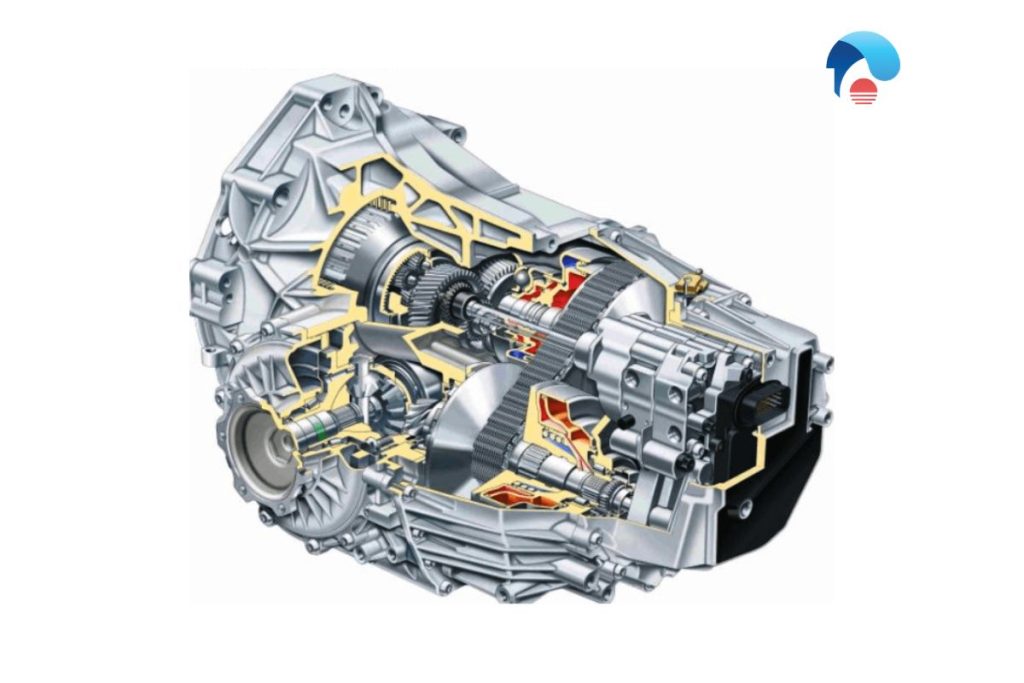
The ECU still retains much of the control (for safety purposes, of course) when you switch to the manual mode. For example, Audi’s Tiptronic transmission keeps shifting from the first to the second gear automatically during manual operation.
It’s also evident from the safety measures performed by the vehicle’s central computer system. Most of the models featuring this transmission have inbuilt protections for high and low RPMs.
If the RPM crosses the maximum limit, the ECU swoops in to correct the gear shifting. Similarly, it performs a downshift when the RPM crosses the lowest limit.
Many modern cars feature the Tiptronic S version of this transmission that automatically switches into the automatic mode if the drive gives no input within 8 seconds. All of these features are standard safety measures that prevent a failure of the engine.
Read More: The Working Principle of a Manual Transmission
The Difference Between Tiptronic and Automatic Transmission
Tiptronic is a kind of automatic transmission but it has some differences from a standard automatic system.
A Tiptronic system gives the drivers the freedom to choose how they want to drive. They can enjoy the hassle-free and easy driving of automatic navigation and the thrill of shifting gears in the manual transmission.
Although it allows speeding up or slowing down, the ECU always oversees whether the RPM crosses the danger limits.
It takes control if anything goes wrong or the driver does not use the shifting for a specific period. On the contrary, the automatic transmission is always in control of gear shifting and RPM.
There are various advanced versions of Tiptronic transmission. For example, the Porsche Cayenne has an 8-speed Tiptronic S version that learns the driver’s behavior and acts in accordance, according to the manufacturer.
Many modern cars have advanced versions of the automatic transmission but none of them has this feature.
Both the transmissions are similar in the sense that they are easy to operate. Even a new driver can operate and make routine trips across city areas.
FAQs on Tiptronic Transmission
Why does my Tiptronic transmission refuse to shift when I tell it to?
The system protects the engine and transmission. If you try to downshift at very high speeds or upshift too early, the ECU may ignore your input.
Can using Tiptronic mode improve fuel economy?
Sometimes. Holding a higher gear at lower RPMs can save fuel, but aggressive manual shifting often hurts MPG more than letting the automatic mode do the work.
Can driving in Tiptronic mode wear out the transmission faster?
Not usually, as long as you avoid constant high-RPM shifting or repeated hard downshifts.
In some cases, manual control can even reduce unnecessary gear hunting.
Is Tiptronic the same thing as paddle shifters?
Not exactly. Paddle shifters are one way to control a Tiptronic-style manual mode, but some cars use a traditional gear lever instead.
Why does my Tiptronic transmission feel jerky at low speeds?
Jerky shifting can happen if the transmission fluid is old, the valve body is dirty, or the transmission control module is having trouble adapting to driving conditions.
Why does Tiptronic mode feel more useful downhill?
Because manually selecting lower gears can help with engine braking, reducing strain on the brakes during long descents.
Can Tiptronic transmissions skip gears?
Some can. Depending on the software, the system may jump from 6th gear to 4th or 3rd if you need rapid acceleration or engine braking.
Does Tiptronic work better with turbocharged engines?
In many cases, yes! Manual control allows drivers to keep the engine in the turbo’s power band for quicker acceleration and better throttle response.
Watch the video from Dayly Driver to understand more about the mechanism of a Tiptronic transmission!
Conclusion
A Tiptronic transmission hands down a driver the best of both auto and manual shifts. You can shift gears without pressing a clutch and stay worry-free because of the built-in safety features.
There is almost zero possibility of making a driving error while running a car with a Tiptronic system.






Are there any work shop manual that I can buy that shows you how to work on a tip tronic gearbox.
My vehicles gear box has failed n it’s a tiptronik, (passo sette) how do I go about it ? Kindly advise
What could be the problem with my car which has no power even after servicing and replacing spark plugs
my toyota corrolla 2008 is pruducing hissing sound ob cold start only.what could be the problem
I like that technology
Hi there. The gearbox shown is not a tiptronic? It is a cvt transmission That is no longer used by the VW/Audi group.,
My pajero 4m41 is not pulling or giving power in its automatic transmission but when you take it in manual transmission it’s able to pick up gears and pull fast with power what could be the problem?