


Night driving offers a more relaxed environment and lets you drive a lot further due to lighter traffic. However, driving at night is actually more dangerous per mile compared to driving during the day. Because visibility is reduced, your reactions are delayed and you are fatigued.
Whether you have to drive a long distance to return home or travel multiple states over to pick up your vehicle from a port, here is what you can do to drive at night more safely.
Contents
Plan your stops before you leave
The most important night-driving decision happens before you start the engine: where will you stop?
Many drivers plan to “just pull into a rest area” when they get tired. After dark, that plan often fails. On busy interstates, rest areas and truck stops fill up quickly at night, mostly with tractor-trailers. Truck drivers have to stop when their federal hours-of-service limits run out, and there aren’t enough truck parking spaces across the country. The problem is serious enough that fleets now book parking in advance through platforms like TruxSpot, rather than hope for an open space. If professional drivers plan their stops, so should you.
Before a long night drive:
- Pick two or three places to stop along the route, such as a motel, a 24-hour gas station or a well-lit rest area.
- Note how far apart they are, so you know your next option if one is full.
- Plan a break at least every two hours, even if you don’t feel tired.
Get your headlights right
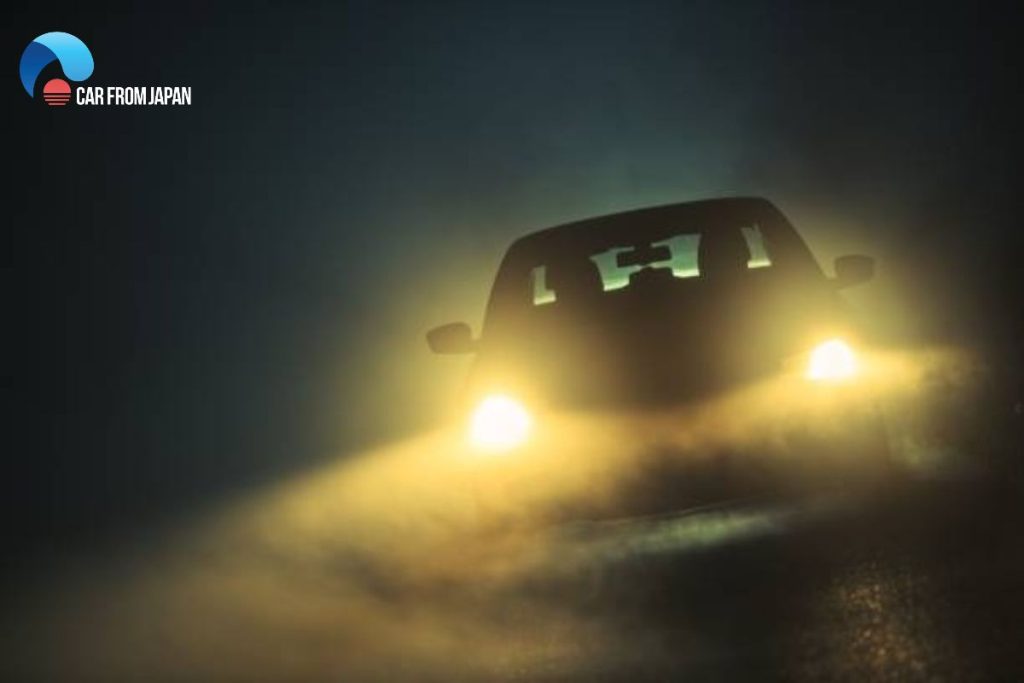
Your headlights are your main safety system at night, and they’re often in worse shape than drivers think.
- Clean the lenses. Dirt and road film can noticeably cut light output. Clean them every time you fill up.
- Fix cloudy lenses. Older plastic headlights turn yellow and hazy. A restoration kit or new lenses can make a big difference.
- Check the aim. Headlights that point too low shorten your view. Headlights that point too high blind other drivers. If you’ve changed the suspension or the bulbs, have the aim checked.
- Check your bulbs. Replace them in pairs, so both sides give the same light.
If you drive a car imported from Japan, check the beam pattern too. Headlights built for left-hand traffic aim the bright part of the beam toward the left side of the road, which is where US oncoming traffic is. Ask a mechanic whether your car needs adjusted or replacement headlight units for US roads.
Use your high beams, and dim them on time
On dark rural roads, use your high beams whenever no one is near. Many drivers forget to switch them on and drive slower than their view really allows.
Dim them when another car approaches, or when you’re following someone closely. Most states set specific distances for this, usually a few hundred feet. Check your state’s driver handbook for the exact rule.
Handle glare from other cars
When an oncoming car blinds you, don’t stare at its lights. Look down and to the right, at the white line on the edge of your lane, until the car passes. Slow down a little if you need to.
A few other things help:
- Keep your windshield clean inside and out. A film on the inside of the glass scatters light.
- Dim your dashboard lights. A bright screen makes it harder for your eyes to adjust to the dark road.
- Flip your rearview mirror to its night setting.
Take fatigue seriously
Drowsy driving is one of the biggest risks at night. NHTSA counts it as a cause of thousands of crashes every year, and experts believe the real number is higher.
Watch for these warning signs:
- You yawn a lot or keep blinking.
- You can’t remember the last few miles.
- You drift out of your lane or hit the rumble strip.
- You miss your exit.
If you notice any of them, stop as soon as it’s safe. Opening the window or turning up the radio doesn’t fix fatigue. Coffee and a 20-minute nap can help for a short while, but the only real fix is sleep. That’s another reason to plan your stops before you leave.
Watch for wildlife
Deer are most active at dusk and dawn, and fall is the peak season. In rural areas, scan the edges of the road, not just the lane ahead. If you see one deer, slow down, because more are usually nearby.
If a collision can’t be avoided, brake firmly and stay in your lane. Swerving into oncoming traffic or a ditch is often worse than hitting the animal.
At night, a large share of highway traffic is long-haul trucks. Give them extra room. Pass on the left, don’t linger beside the trailer, and don’t cut in front of them. Slow down near on-ramps and shoulders too, because trucks sometimes park there when there’s nowhere else to stop.
The short version
Night driving is safest when you plan it. Know where you’ll stop before you go. Keep your headlights clean and aimed. Use your high beams when you can, and look away from glare. Stop at the first sign of drowsiness. Watch for deer and give trucks room. Do that, and the miles after dark can be some of the easiest of your trip.